How a Theo Fabergé Masterpiece Is Created
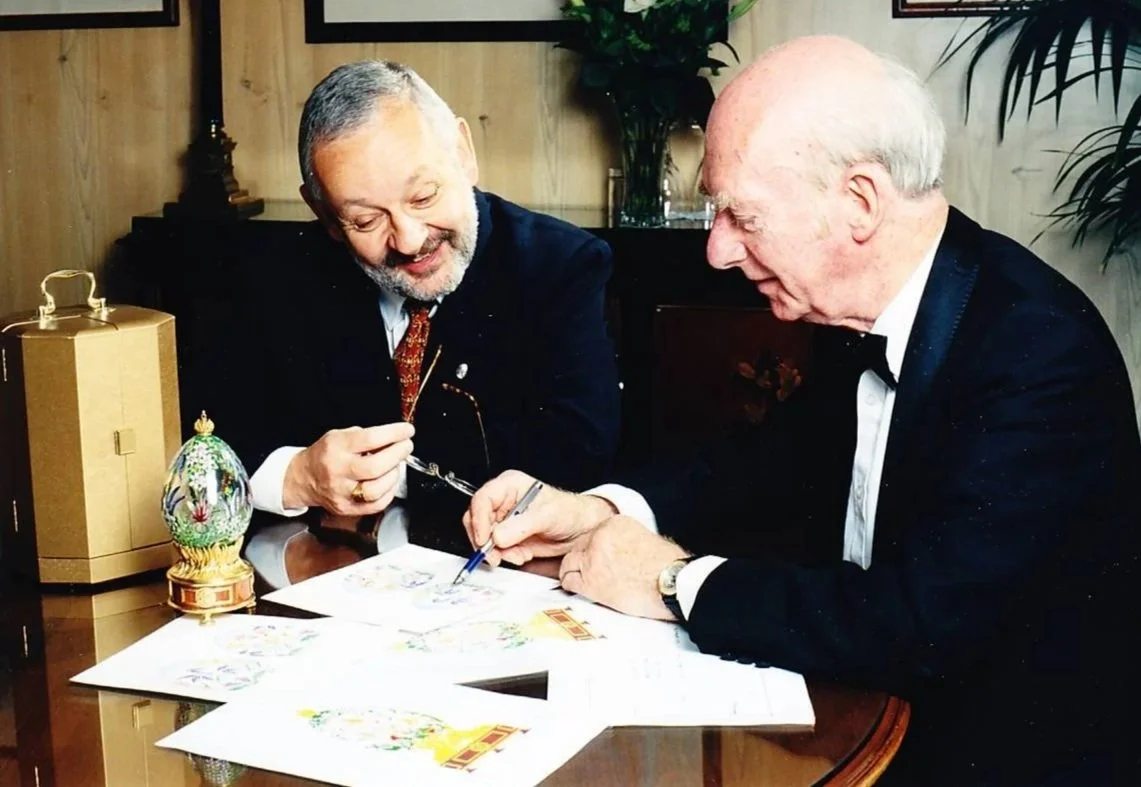
Becoming a Theo Fabergé Craftsman
To work for Theo Fabergé was not simply to accept a commission.
You had to:
Be at the very top of your craft
Agree to train a young apprentice — non-negotiable
Each artisan had to understand the process and work to the same exacting standards of precision and attention to detail that defined Theo’s own work.
Theo never asked a craftsman to do something he would not do himself. One ornamental turner joined us at 17 and trained under Theo for four years. Today, she is regarded as one of the world’s leading ornamental turners.
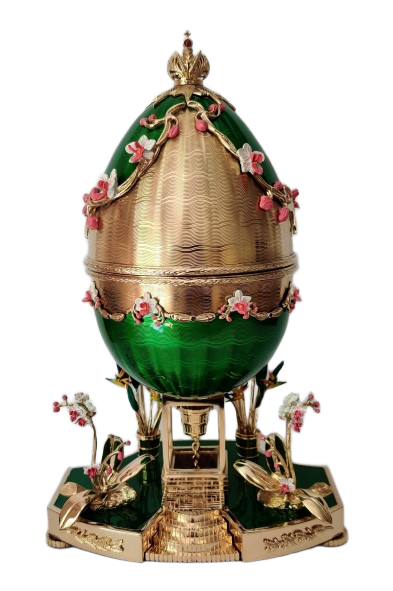
Each craftsman has their own speciality. A piece such as the Garden Egg takes over nine months to complete and requires more than twelve different masters.
Without a factory, components are constantly moving from one studio to another — a logistical challenge refined over more than forty years.
When every specialist has completed their part, everything must fit perfectly. This is why every single component is drawn with exact measurements. When final assembly begins, nothing is forced. Everything aligns exactly as intended.
That precision — from sketch to final fitting — is what defines a Theo Fabergé creation.
The exacting standards behind this work grew from Theo’s precision-engineering background and his later mastery of ornamental turning.
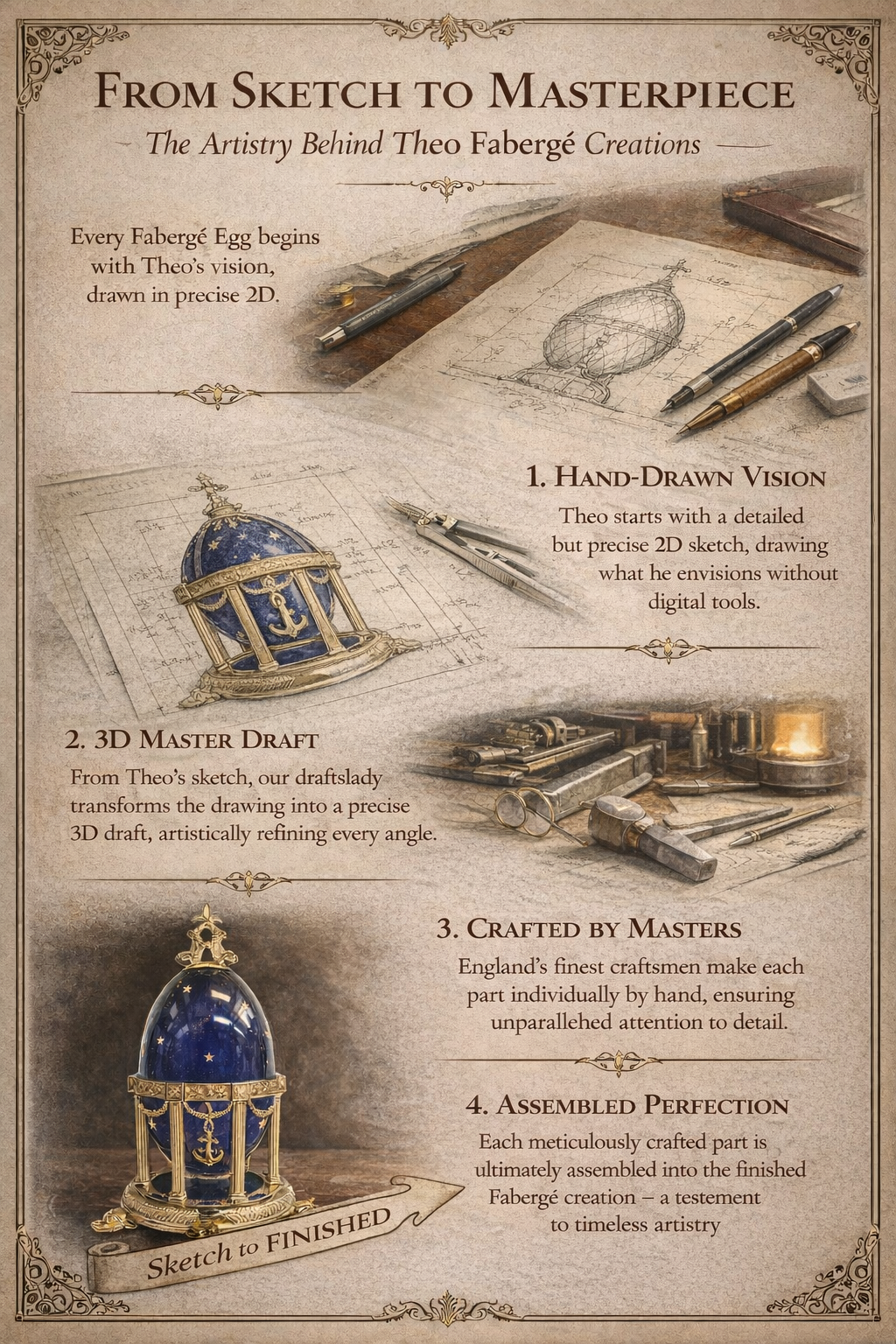
The Beginning: Design Without a Factory
Creations Theo Fabergé was formed in 1984, with Theo immediately leading the design of every piece.
There was no rigid formula. Often, Theo would simply make a piece and declare, “That’s the next one.” Other times, he would produce a precise 2-dimensional drawing — never 3D, never digital — resolving the proportions entirely in pencil.
The first person we ever hired was a lady, and she remains with us today. Her role is vital as she takes Theo’s 2D drawings and reinterprets them into detailed 3D technical drafts, preparing them for production.
Every two weeks, Philip—the Chairman—would visit Theo at his studio. Designs moved back and forth, refined again and again, until Theo was satisfied. There was no formal approval process. Sometimes he signed and dated the drawing. Sometimes just a tick. Sometimes, simply the words, “Go ahead.”
Once approved, the design returned to our draughtsperson. They would break the creation down into its many individual components — often dozens of parts — each carefully measured and documented.
And here is what makes us different:
We have no factory.
If you want the very best craftsmen, they will only work in their own studios. Over the years, we have assembled more than 30 of England’s finest master artisans, each a specialist in their field. Every creation—except our watches, which are made in Switzerland—is produced entirely in England. Nothing comes from the Far East. Not even a screw.
We are likely one of the largest private patrons of England’s top craftsmen.
The Guilloché Enamel Egg
Precision Before the Fire
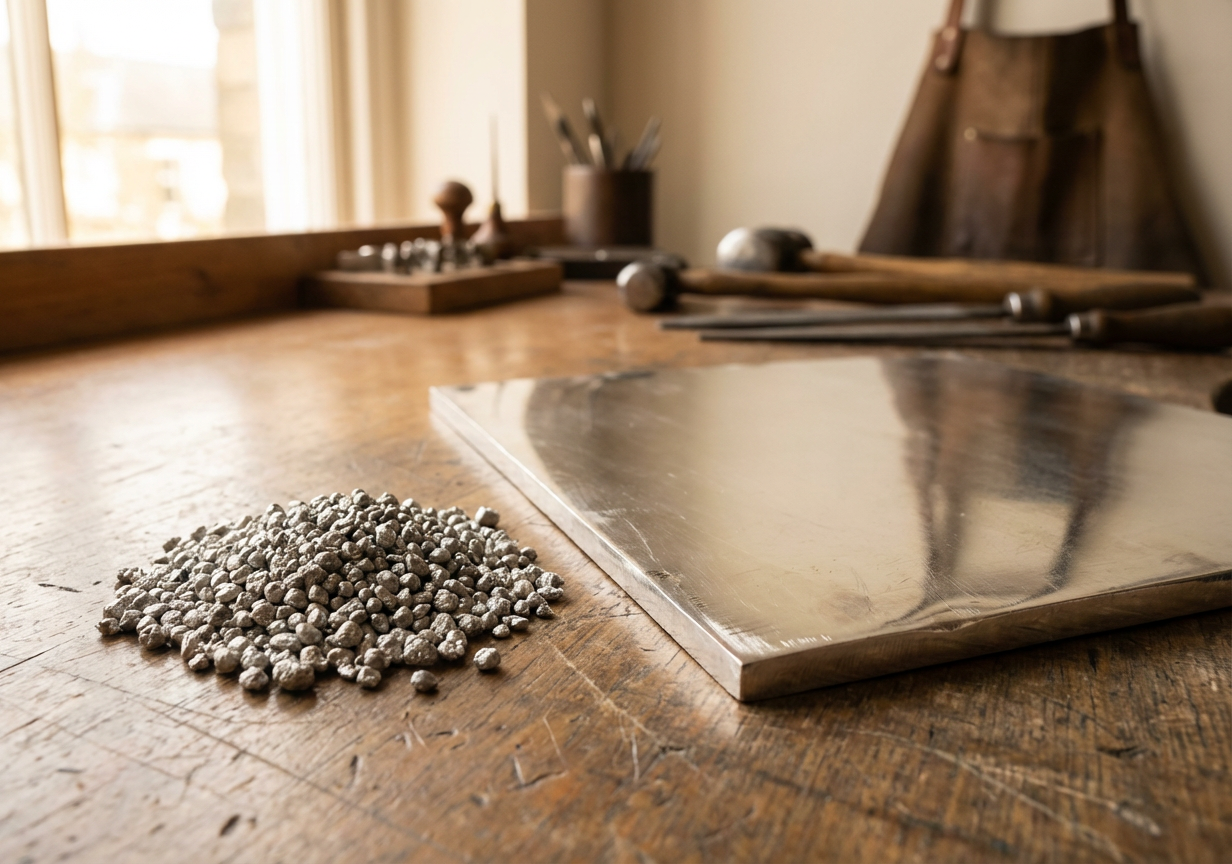
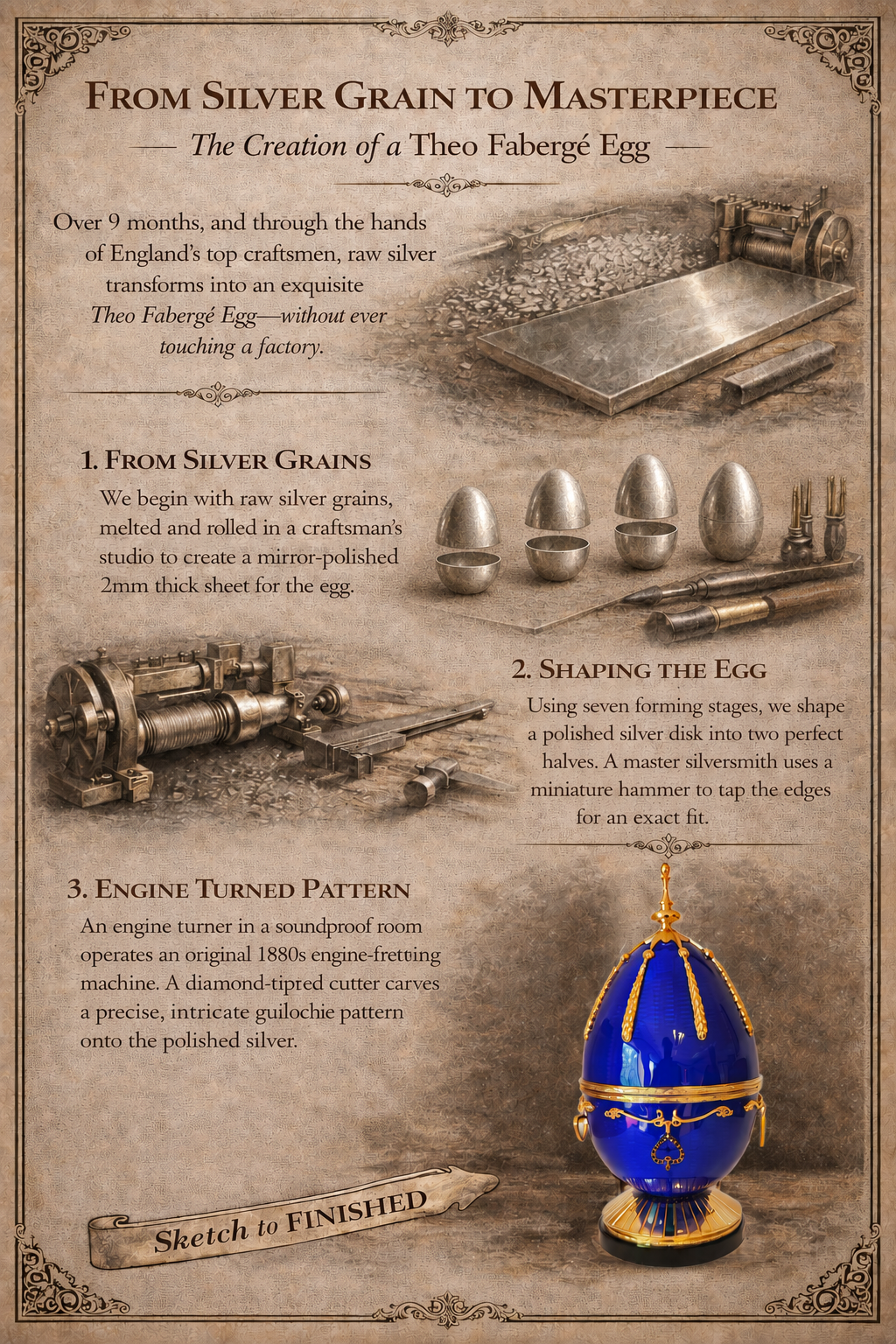
Before colour, before enamel, before brilliance — there is silver.
This Guilloché enamelled egg reflects the technique that made Carl Fabergé famous. Yet long before enamel is applied, the discipline begins in metal.
It starts with grains of silver. These are melted and rolled into sheet form—a transformation that immediately increases the metal’s value. The sheet is 2mm thick — heavier than most would expect — and from it, two discs are cut: a larger one for the top and a smaller one for the base.
Each surface is polished repeatedly until it reaches a flawless mirror finish. Front, back, edges — perfection is not optional. Any mark left at this stage will only be magnified later beneath translucent enamel.
The discs are then shaped through seven separate formers. The first introduces the slightest curve. Each successive former deepens that curve until the silver begins to resemble the final form.
But forming alone is not enough.
The top and bottom must meet exactly. A master silversmith takes a miniature hammer and gently taps—sometimes for days—adjusting by fractions of a millimetre until the two halves align seamlessly.
Once they meet perfectly, the silver is polished again — inside and out — restoring a flawless surface.

Engine Turning
Now comes Guilloché — the intricate engine-turned pattern cut into the silver beneath the enamel.
This is carried out on original 1880s engine-turning machines. No one manufactures them today. We own three.
The piece is secured in the machine while a single diamond cutter carves the pattern. The engine turner memorises the design entirely — like an opera singer knowing every word without looking at the score. Depending on the machine, up to twelve wheels control minute directional shifts.
A fraction too far in the wrong direction, and the geometry is broken.
There is no correction.
If a mistake is made—even halfway through—the process must be restarted from the first stage.
For this reason, engine turning takes place in a soundproof room. Concentration must be absolute.
If the pattern is completed successfully on both halves, the silver is not polished again. Instead, it is meticulously cleaned. Every microscopic cut must be free from dust.
Because the next stage is fire.
And once enamel is applied and fired at temperatures approaching 800°C, even a single grain of dust will burn beneath the surface, leaving a permanent flaw.
Enamel's brilliance rests entirely on the perfection of the silver beneath it.
Colour by Fire, Perfection by Loss
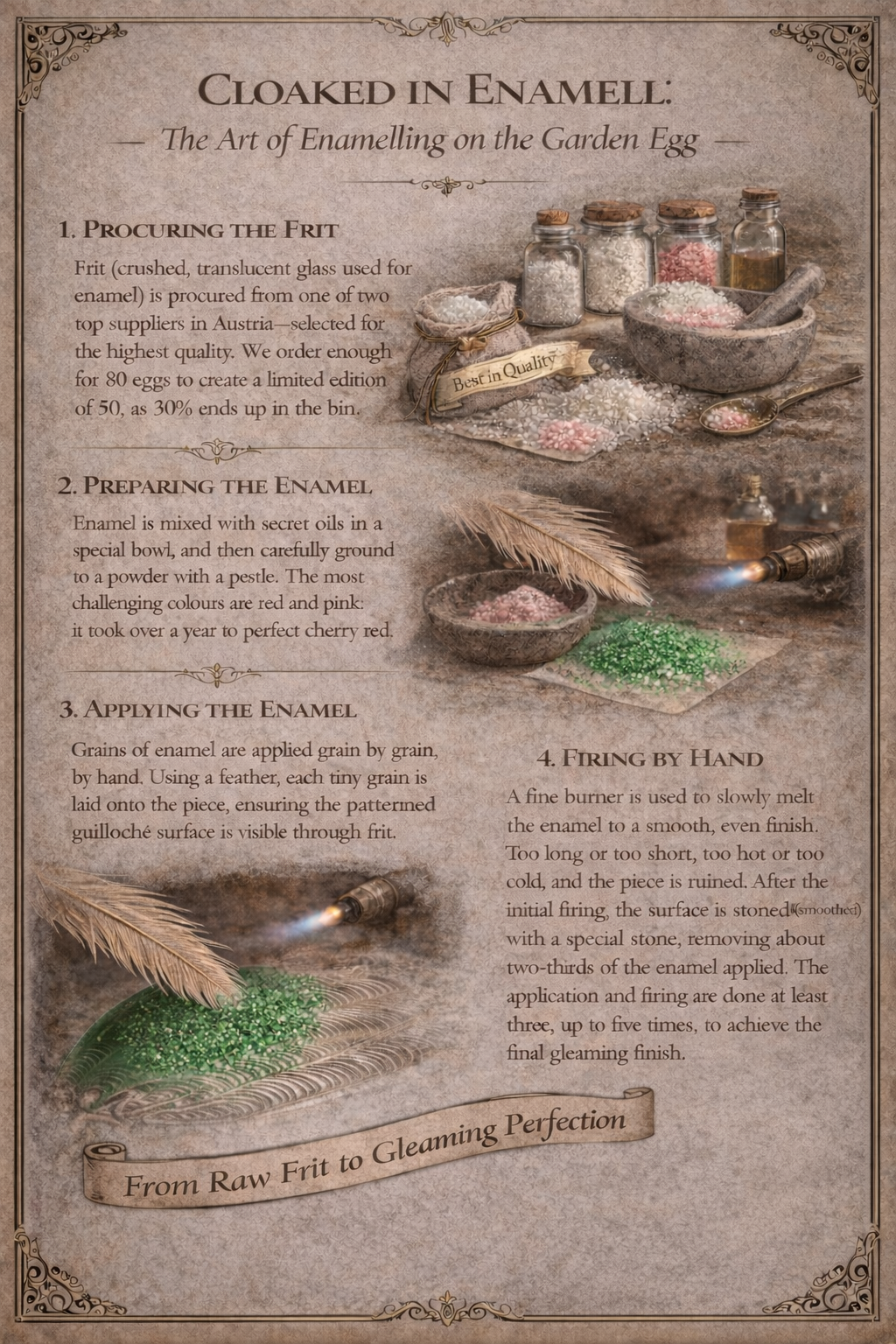
The enamel used on the Garden Egg is known as frit — a translucent glass that allows the engine-turned pattern beneath to remain visible.
There are only two suppliers of this quality in Austria, and one elsewhere. We use the Austrian supplier for consistency and depth of colour. Even within a single shade — take white, for example — there are twelve distinct variations.
Before enamelling begins, we must determine the size of the edition.
Why?
Because enamel must be purchased in a single batch, colour variations occur between batches. Just as with carpet or fabric, consistency is everything. If we intend to produce 50 pieces, we will order enough enamel for 80, allowing for the reality that up to 30% may be lost during the process.
Yes. Thirty percent.
Once the enamel arrives, it is inspected. A small quantity is mixed with specialist oils and crushed into a fine powder. Each colour behaves differently. Red and pink are the most difficult.
Our Firebird Egg — a deep cherry red — took over a year to perfect. You might assume this shade existed for centuries. Carl Fabergé achieved cherry red — but at a cost. In the 19th century, red enamel relied heavily on arsenic, lead, and mercury.
Today, those substances are rightly prohibited.
Modern enamel is safer — and considerably more difficult to master.
Applying the Colour
Enamel is not brushed on like paint.
Using a feather, grains of powdered enamel are placed carefully onto the silver surface — grain by grain. A small section is completed before a fine flame is introduced.
The heat must be exact.
Too fast, it cracks.
Too slow, it burns.
Too long, it distorts.
Too short, it fails to fuse.
There is no adjustment once fired.
If it goes wrong, the process has to be restarted from the first stage.
Section by section, the entire surface is covered. At this stage, the enamel appears uneven. It is not polished. Instead, it is stoned — gently abraded with a specialist stone, removing up to two-thirds of the newly applied enamel.
Then the process begins again.
For red, this may be repeated five times.
For blue, perhaps four.
A single top and bottom may take over a month to complete — not counting the pieces lost along the way.
Pink remains one of the most difficult colours of all. Even historical pieces displayed in St. Petersburg often show slight orange edging — a common reaction within the enamel.
Theo would not accept that.
If it was pink, it had to be truly pink. No orange.
This meant more pieces were rejected in the trial process.
Thousands of enamel colours are available.
But mastery lies not in choosing colour —
It lies in controlling fire.
The Wax Beginning
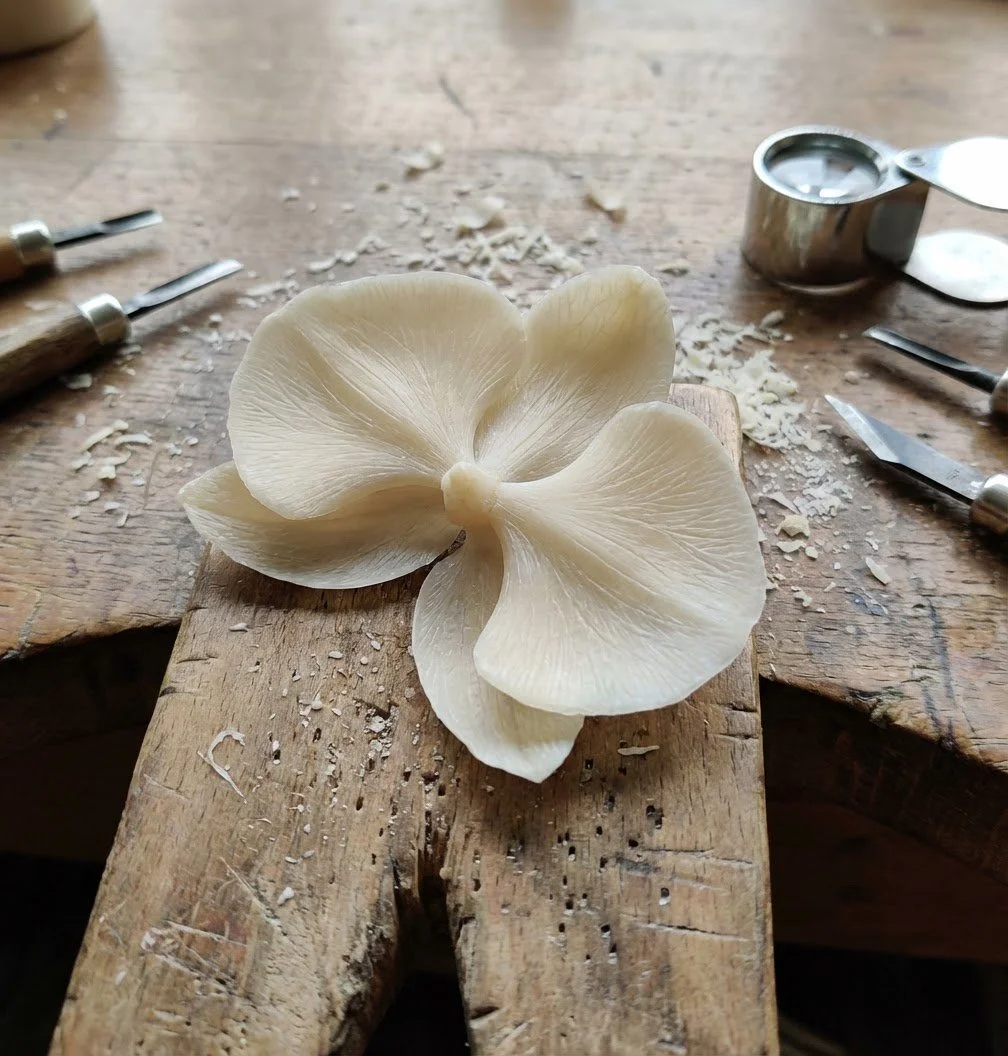
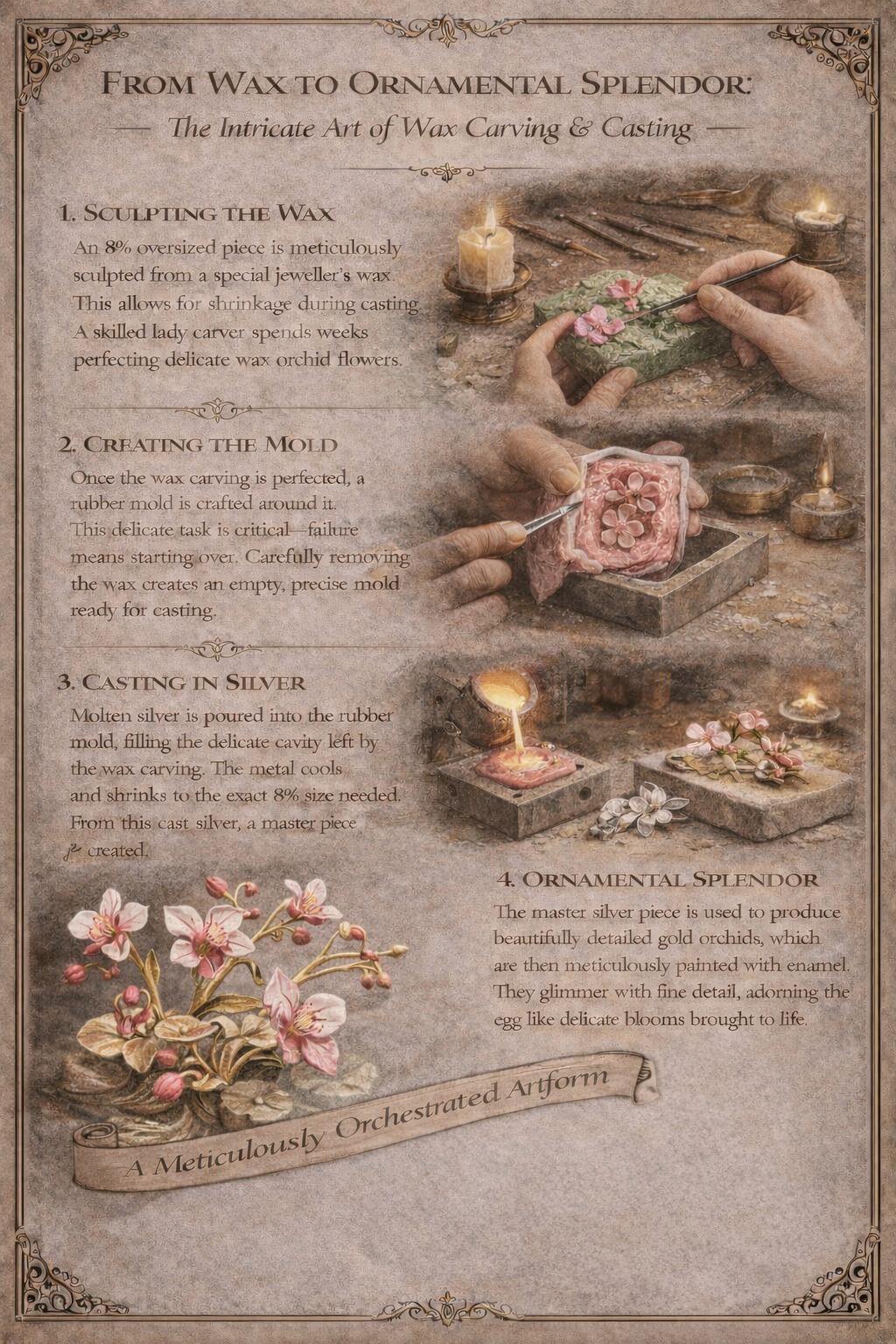
These flowers begin not in metal, but in wax.
They are carved from a solid block — slightly larger than required, approximately 8% bigger — to allow for contraction during casting. Wax is chosen because it allows extraordinary detail. Every vein of a petal, every delicate curve, can be refined before metal is ever introduced.
But wax is fragile.
Like candle wax that cools and snaps at the slightest pressure, a carving can break in an instant. One such flower may take six weeks to complete. If it fractures, it must be carved from the beginning again.
Once the wax is approved, there is only one opportunity to create the mould. Rubber is formed around the carving. If the mould fails — and sometimes it does — the entire process returns to the wax stage.
From the successful mould, metal is cast. That first casting becomes the master from which the final elements are produced.
From Wax to Gold
Every Theo Fabergé creation begins with a story.
The Garden Egg features orchids, roses, and bird-of-paradise flowers — Theo’s three favourite blooms. They are not decorative afterthoughts. Nothing was ever created simply because another company had done it first. There was never a moment of, “They’ve made one — we should make one.”
Each design stood entirely on its own.
That is why the collection is so varied. One piece bears no resemblance to the next. Theo’s imagination did not repeat itself, and he was never offended if someone did not love a particular creation. His view was simple: you are not meant to love everything; you are meant to connect deeply with something.
The Crystal Enamel Egg
Crystal Enamelling
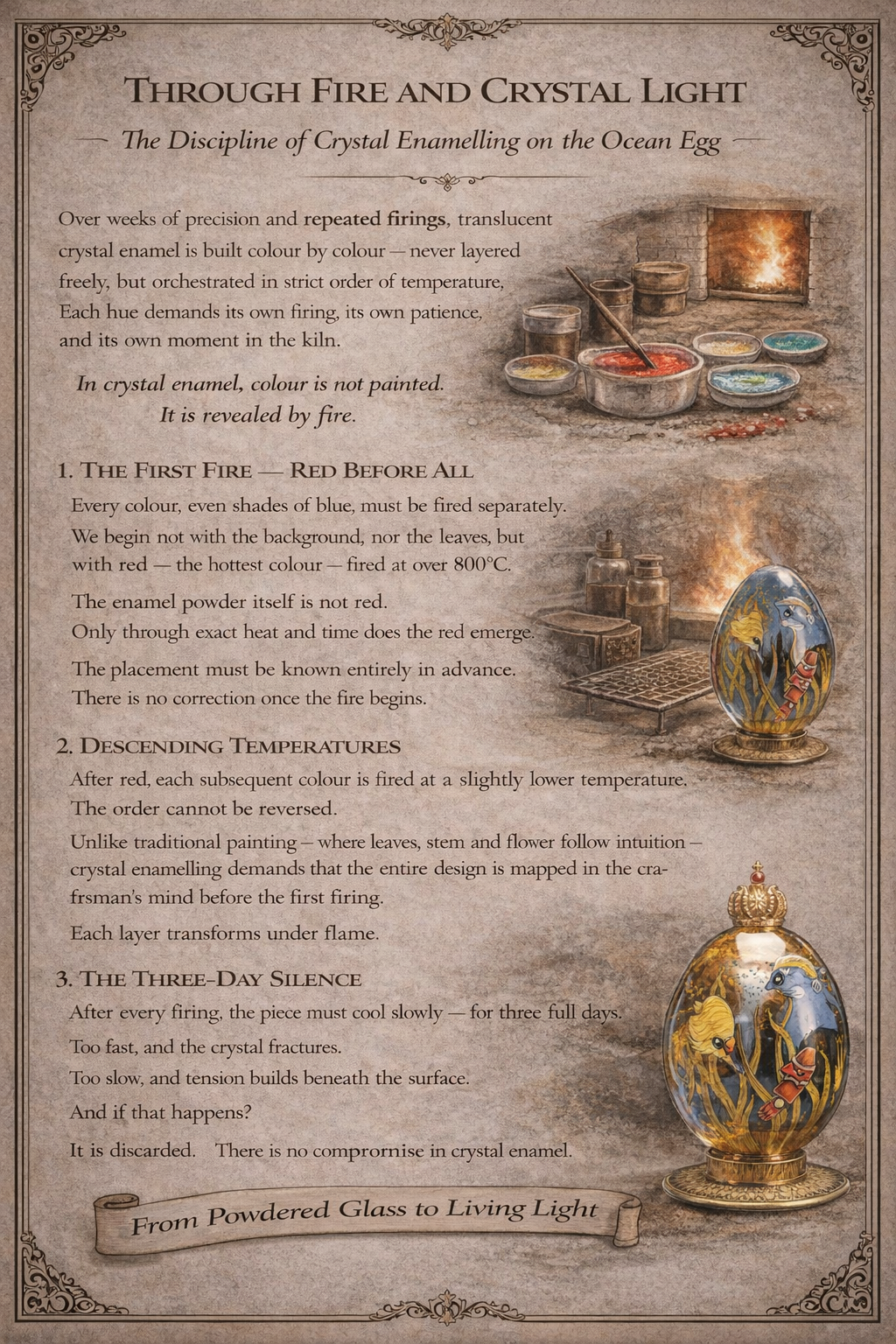
In crystal enamel, colour is not applied intuitively — it is executed in strict sequence.
Every colour, even different shades of blue, must be fired separately. And always, we begin with red.
Red demands the highest temperature — just over 800°C. It must be fired first, before any other colour touches the surface. The enamel powder itself is not red; it appears colourless. Only through exact heat, held for a precise duration, does the red reveal itself.
This requires total foresight.
Unlike painting — where one might begin with leaves, then the stem, then the flower — crystal enamelling demands that the entire design be mapped out in the artisan’s mind before the first firing. Every placement of red must already be decided. Once fired, there is no adjustment.
After red, the sequence descends in temperature. Each subsequent colour is introduced and fired at a slightly lower heat.
The order cannot be reversed.
The Three-Day Silence
After every firing, the piece must cool — slowly — for three full days.
Too quickly, and the crystal fractures.
Too slowly, and internal tension builds beneath the surface.
Only when it has rested completely can the next colour be applied.
The Ocean Egg contains multiple hues. The yellow alone is often the fifth firing. If left in the kiln even fifteen minutes too long, that yellow turns to burnt orange.
And if that happens?
It goes in the bin.
The enamelling alone can take a full month — not counting the pieces lost along the way.
In crystal enamel, there is no correction.
Only preparation, precision, and fire.
The Theo Fabergé Guilloché Enamel Watch
A Masterpiece in Miniature
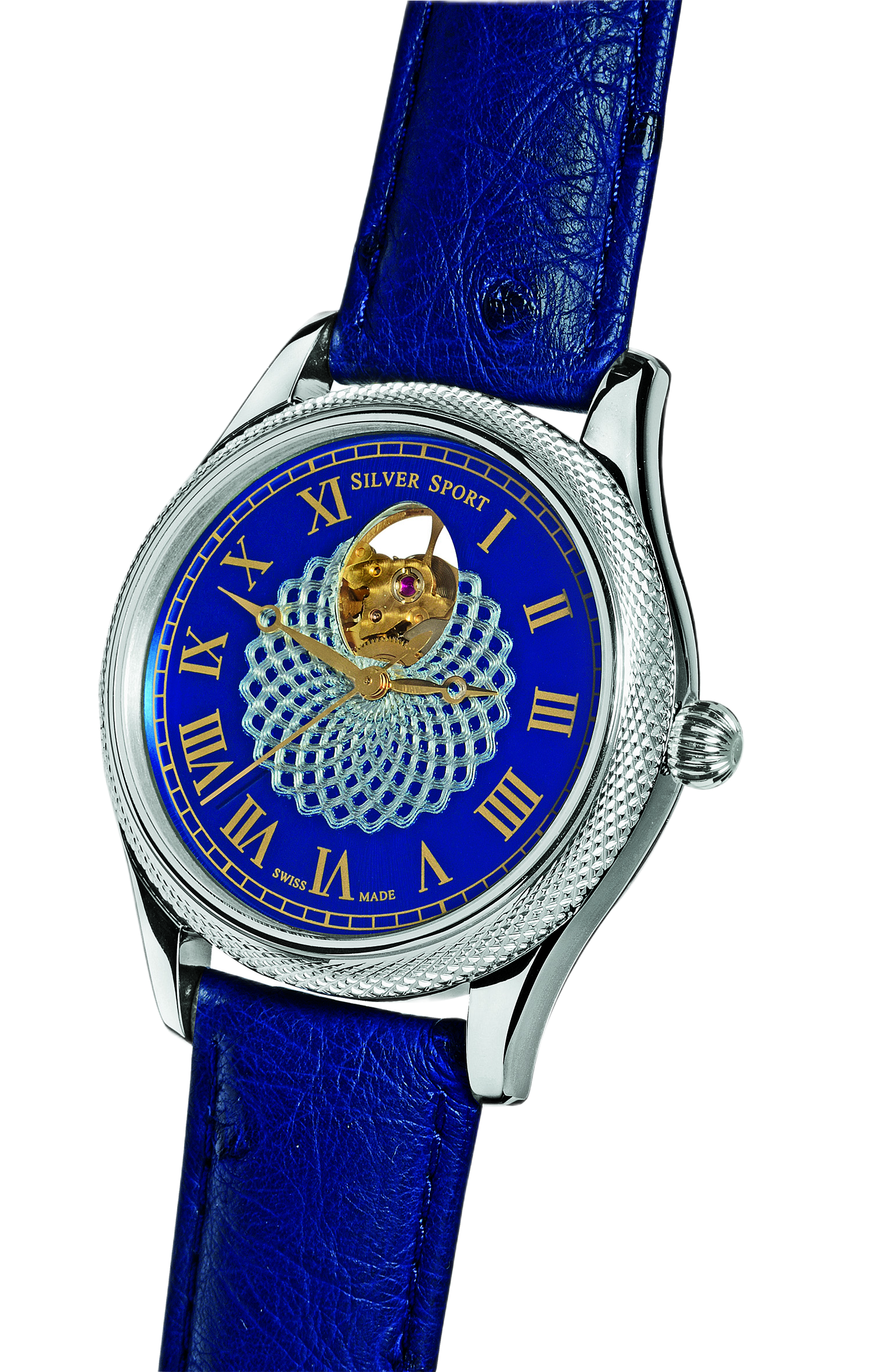
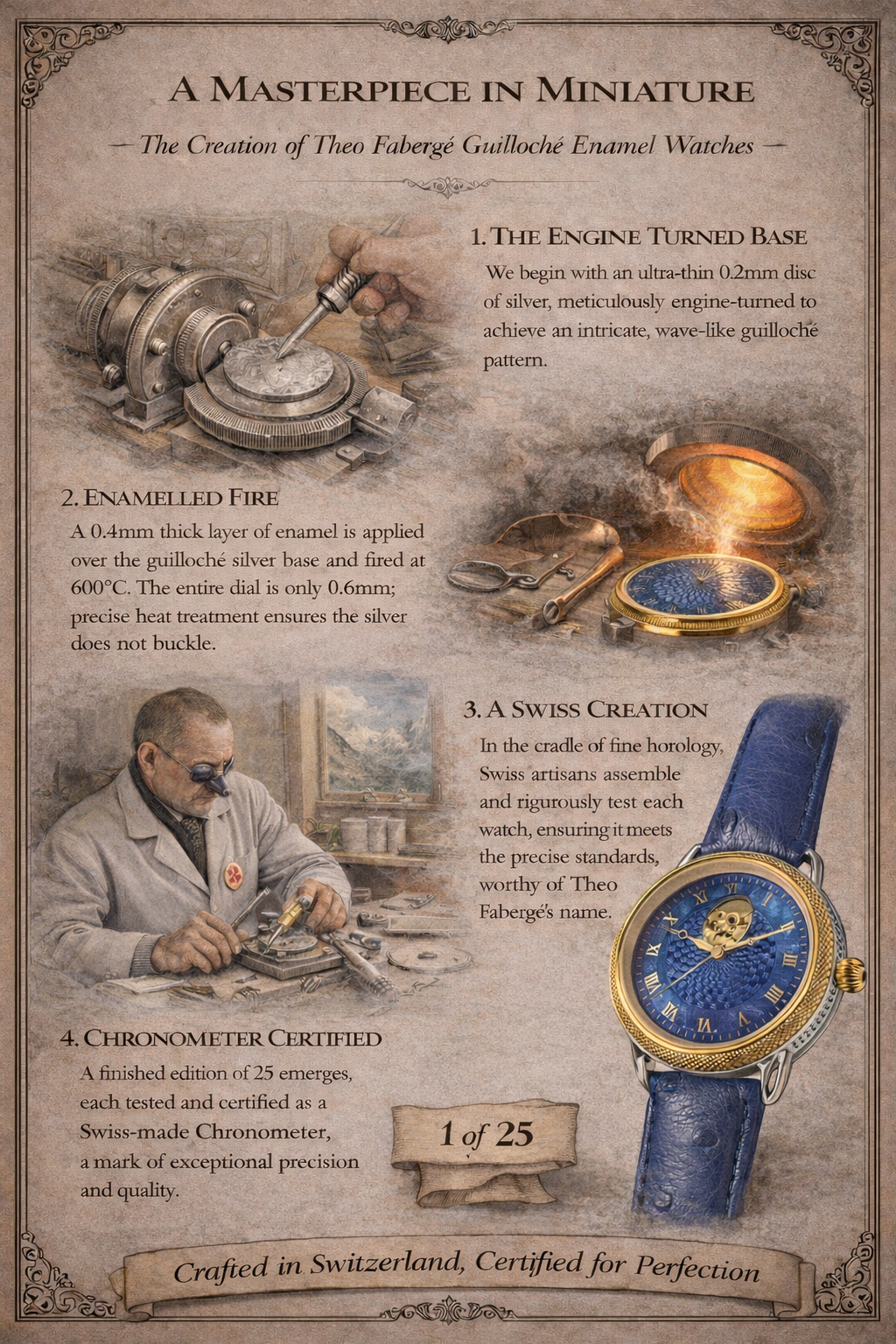
A Theo Fabergé watch dial is a study in restraint and precision.
The entire face is just 0.6mm thick.
Beneath the surface lies a 0.2mm engine-turned silver disc, hand-cut with an intricate guilloché pattern. Over this, a 0.4mm layer of translucent enamel is applied and fired at approximately 600°C.
The question is simple:
How do you heat a sheet of silver thinner than a coin to 600 degrees — and prevent it from buckling?
This is where mastery begins.
The silver must be perfectly tensioned. The heat must rise evenly. The firing time must be exact. Too much expansion causes the dial to distort. Too little and the enamel will not fuse correctly. There is no margin for adjustment once fired.
This delicate balance is why so few workshops attempt true guilloché enamel watch dials today.
The difficulty is not decorative — it is structural.
At one stage, even Patek Philippe — for those who understand fine horology — approached us to produce guilloché enamel dials for them. It was a significant honour.
Swiss Made. Selectively Certified.
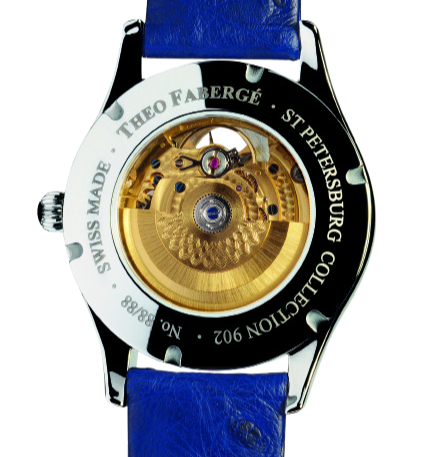
All Theo Fabergé watches are assembled in Switzerland — the historic home of fine horology — where specialist watchmakers regulate and test each movement to exacting standards.
However, only the limited edition of 25 pieces is submitted for official Chronometer certification.
A Chronometer is not a descriptive term — it is an independently tested standard of precision. Each movement in the 1 of 25 edition undergoes rigorous multi-day testing in different positions and temperature conditions. Only those that meet strict tolerances for timekeeping accuracy are granted certification.
The other editions — such as 1 of 88 or 1 of 100 — are regulated to Swiss standards but are not submitted for Chronometer certification.
This distinction is deliberate.
The 1 of 25 edition represents the highest mechanical specification within the collection — combining traditional decorative artistry with officially certified precision.
For us, beauty is essential, but precision, when chosen, must be proven.
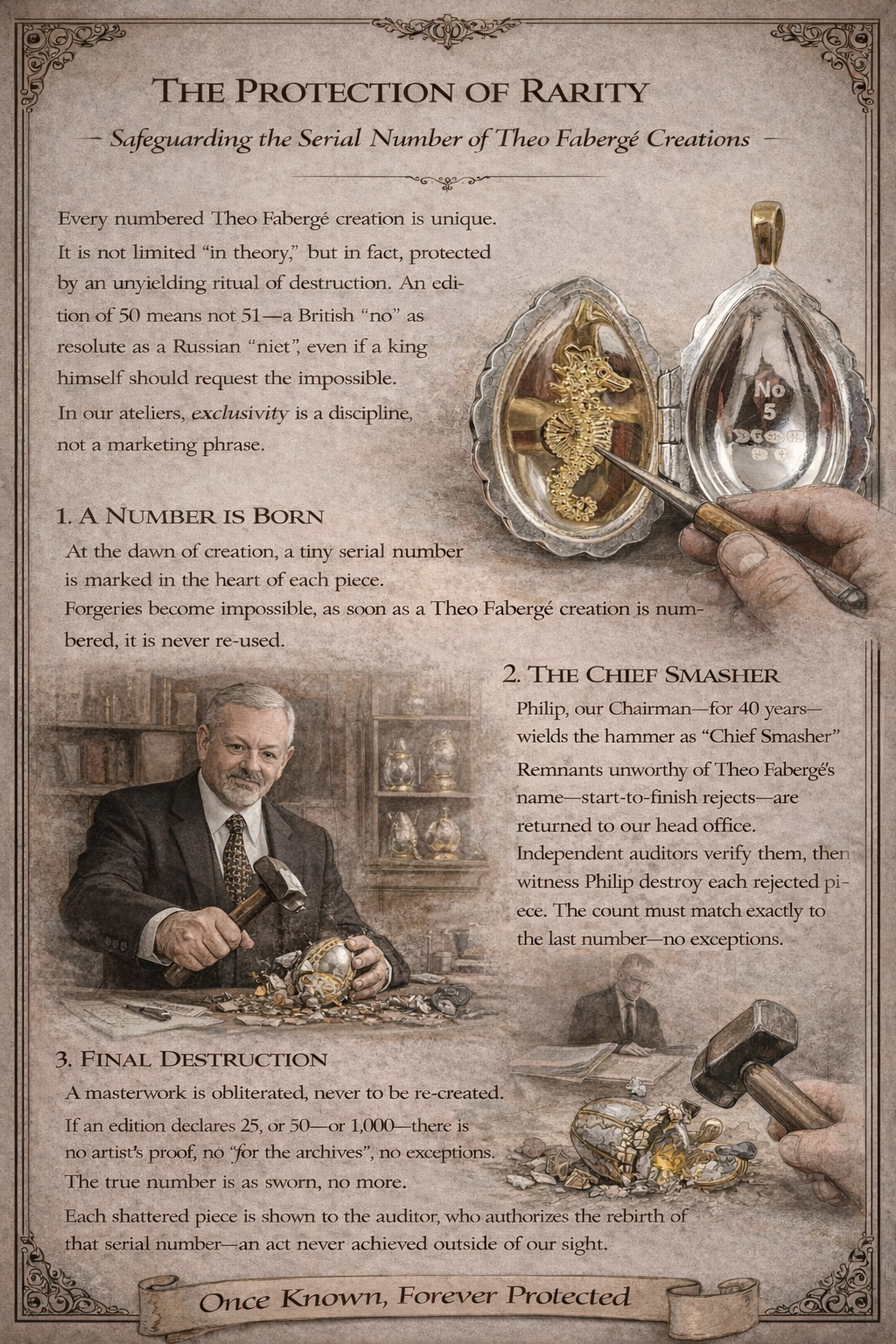
The Protection of Rarity
Where a Number Becomes a Promise
When we declare an edition of 50, it means 50.
Not 51.
Not “50 plus one for the archives.”
Not an exception for royalty, collectors, or circumstance.
If the edition is complete, the answer — politely — is no. If someone desperately wishes to own one, the only possibility is to approach an existing collector. We do not create another.
Because the number is not marketing.
It is a promise.
A Number is Born
From the earliest stage of creation, each piece is marked with a tiny number — a precursor to the final serial number. That number follows the piece through every stage of its making.
Security around these numbers is absolute.
They are logged, recorded, and accounted for. When a creation is complete, that number becomes permanent — never to be duplicated.
If we declare 12, only 12 will ever exist.
The Chief Smasher
But what of the pieces that fail?
Those that crack in firing, distort in forming, or fall short of our standard?
They do not quietly disappear.
Each numbered reject is returned to the head office. There, under the supervision of an independent audit company, the serial number is verified in writing.
Only once authorised is the piece destroyed.
Philip, our Chairman — known affectionately as “Chief Smasher” — personally carries out the final act. The auditor witnesses the destruction to ensure the numbered piece can never re-enter circulation.
Only then may that serial number be reassigned.
In over four decades, no number has been duplicated.
Imagine two collectors discovering they both own number 23 of 41.
That cannot happen.
And it never will.
Exclusivity as Discipline
In many limited editions elsewhere, additional proofs or extras quietly appear — an artist’s copy, a printer’s copy, an exception.
We do not follow that path.
If the edition states a number, that number stands.
Once known, forever protected.