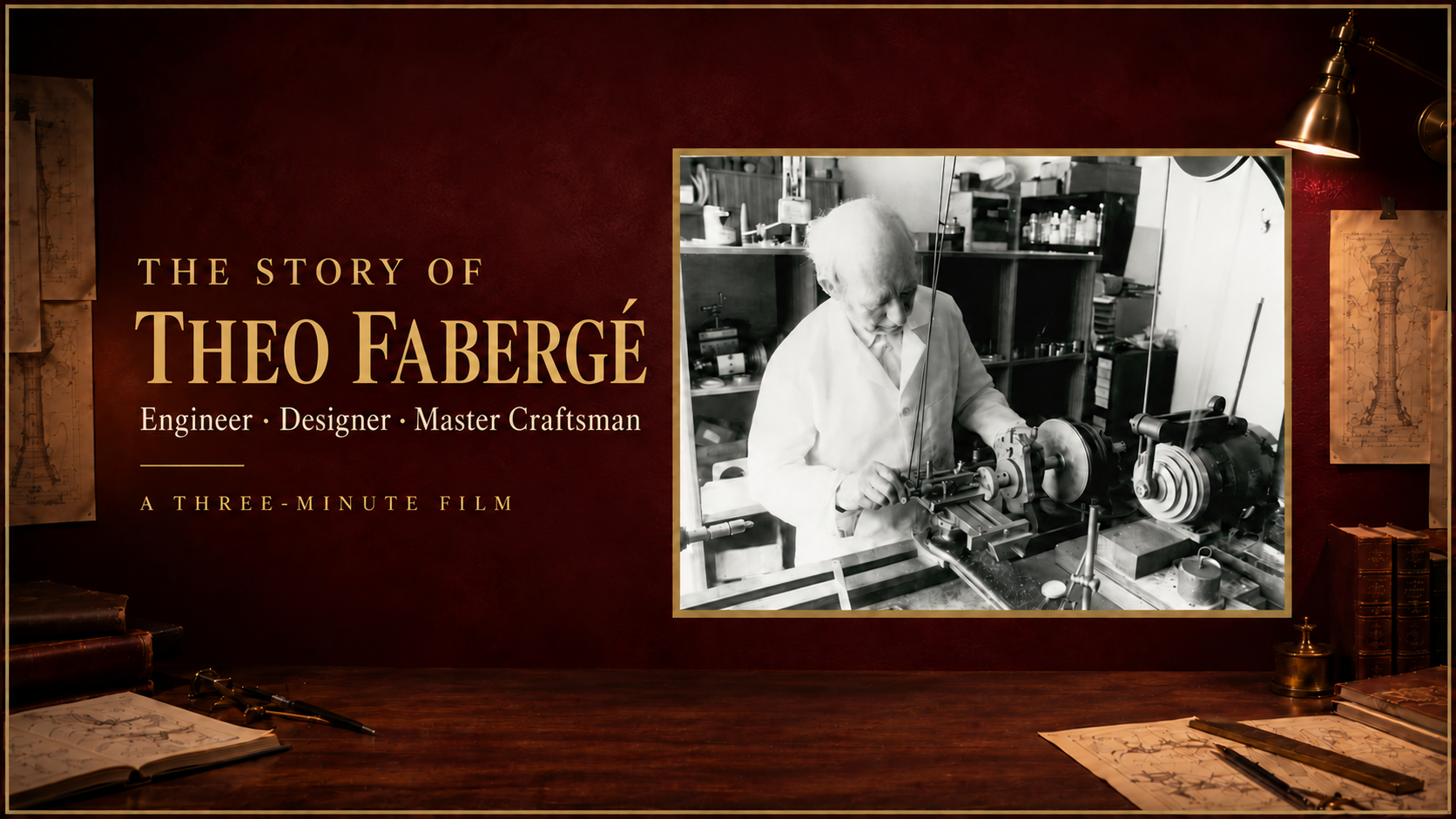
Carl Fabergé: The Man Behind the House
Peter Carl Fabergé transformed a family jewellery business into one of the most celebrated names in the decorative arts. His achievement brought together artistic judgement, commercial understanding and the skills of an exceptional network of specialist makers.
The Imperial Easter Eggs remain the House’s most recognisable works, but they reveal only part of its range. Jewellery, clocks, photograph frames, flower studies and carved animals offered different expressions of the same ambition: to give an object distinction through its design and the quality of its execution.
Understanding Carl’s role helps explain how that ambition became a complete creative enterprise. It also provides a historical context for the original work of his grandson, Theo Fabergé, whose own artistic chapter developed in England.
An Artistic Education
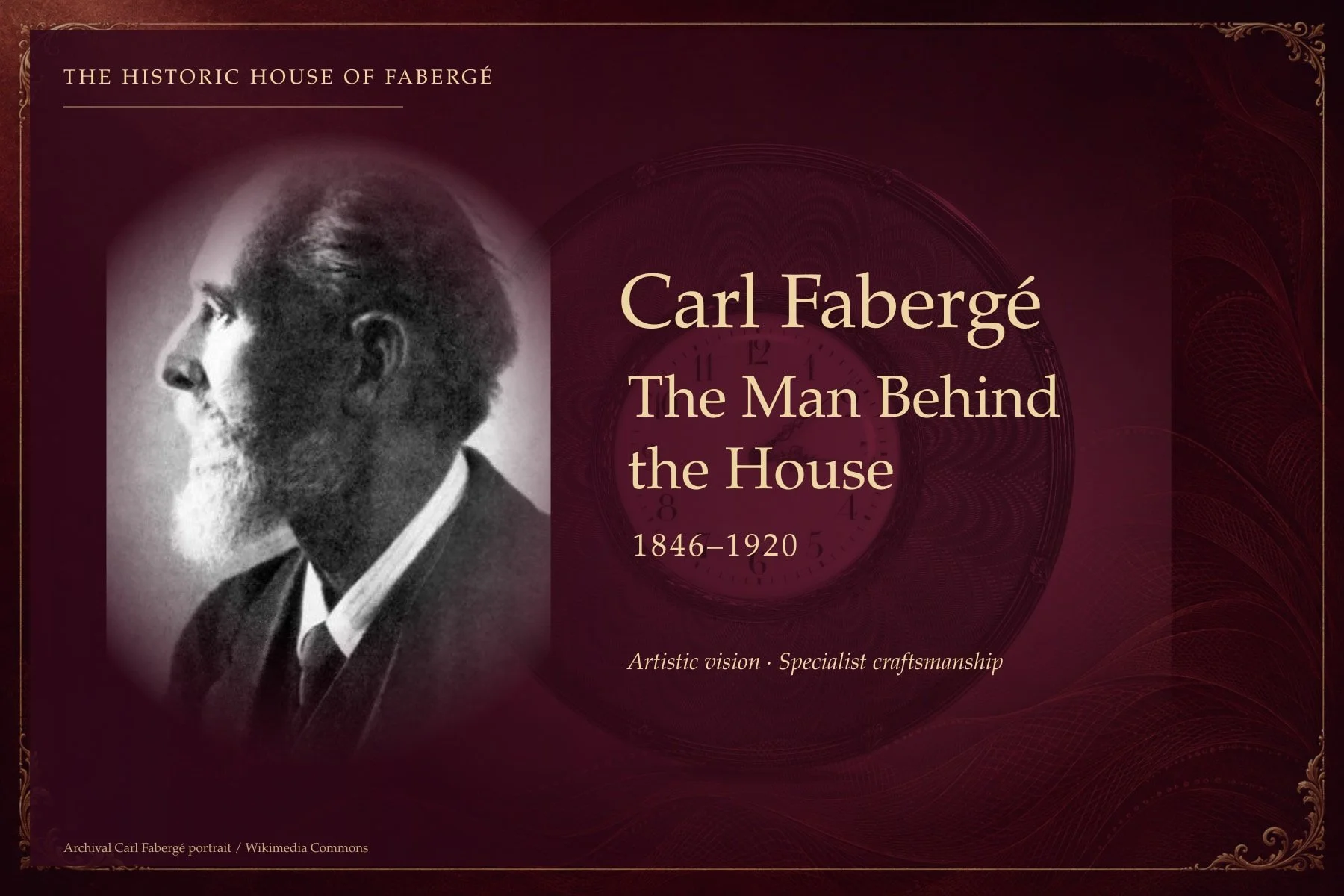
Born in St. Petersburg in 1846, Carl was the son of Gustav Fabergé, who had established his jewellery business in 1842. His preparation for the family firm combined practical instruction with opportunities to study European art and craftsmanship.
Training and travel took him through major centres of jewellery and decorative art. Museums offered a different kind of education: the chance to examine how earlier makers had balanced proportion, colour, ornament and construction.
His work with historic objects at the Imperial Hermitage was particularly important. Repairing and restoring jewellery required close attention to techniques that could be difficult to understand through observation alone. Antique goldwork and eighteenth-century decorative objects became a source of both technical knowledge and artistic ideas.
When Carl took charge of the business in 1872, that education helped him develop a direction in which artistic invention and skilled execution worked together.
The Artist Jeweller
Carl’s approach gave considerable importance to the complete object. The choice of a stone, the character of an enamel colour or the curve of a setting mattered because of its contribution to the design.
This explains the House’s use of materials across a broad spectrum. Gold and diamonds appeared alongside nephrite, agate, rock crystal and other hardstones. Their colour, translucency, and natural markings gave designers possibilities beyond conventional gemstone jewellery.
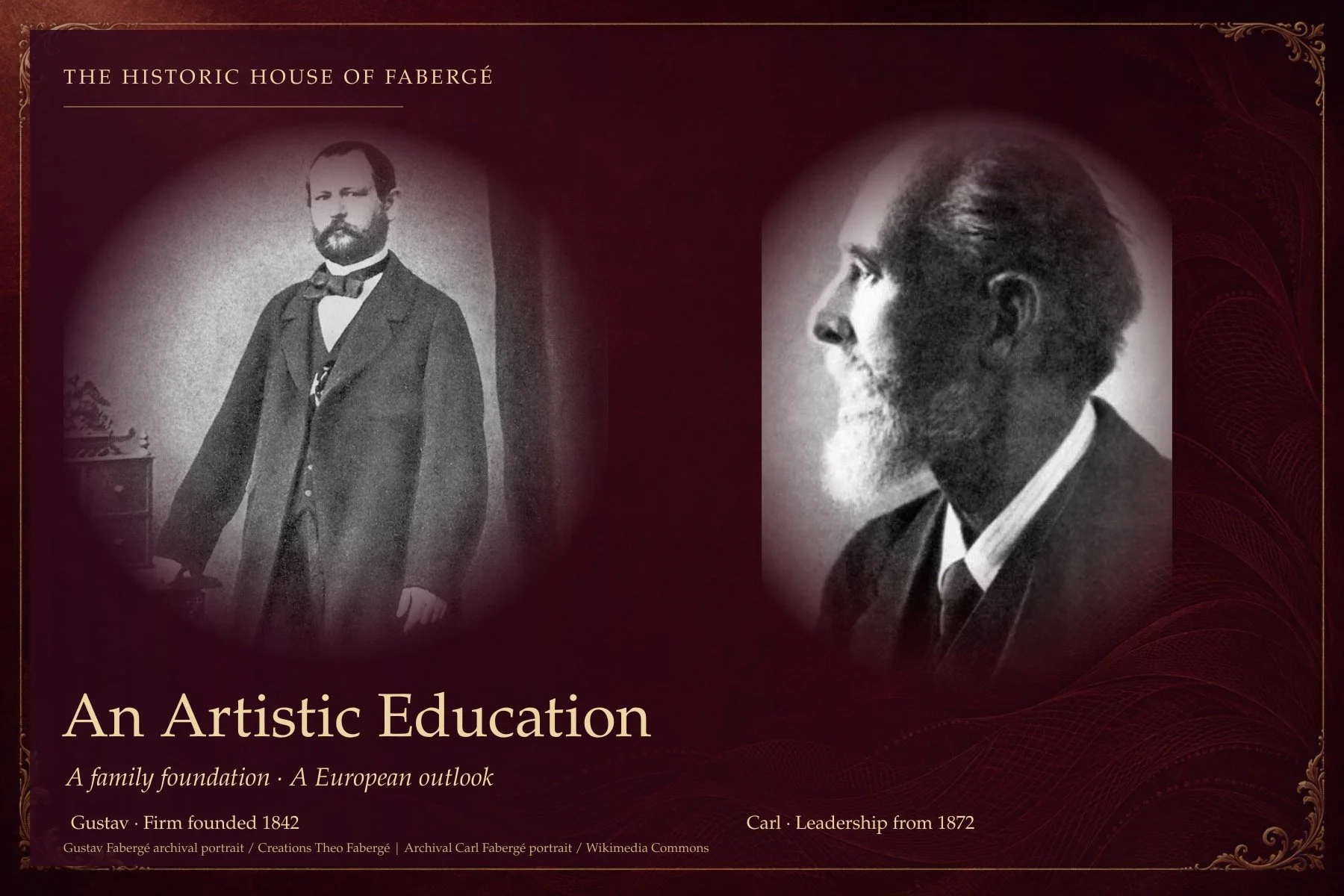
A small photograph frame could express this outlook as clearly as a major commission. A heart-shaped example made under workmaster Mikhail Perkhin before 1896 combines gold, enamel, glass and a photograph. Its scale is intimate, yet its form and decoration give the image within a carefully considered setting.
Such objects invite a collector to look beyond a list of materials and appreciate the decisions that unite them: the handling of colour, the balance of ornament and the relationship between an object’s purpose and its appearance.
A House of Specialist Makers
The historic House’s output depended on collaboration. Carl provided artistic and business leadership, while designers and workshops contributed expertise in goldsmithing, silversmithing, enamel, engraving, stone carving, gem-setting and miniature mechanisms.
Workmasters played a central role in organising production and maintaining standards. Leading figures included Mikhail Perkhin and his successor, Henrik Wigström, along with specialists such as August Holmström and Julius Rappoport. Carl’s younger brother Agathon contributed to the design direction, and Franz Birbaum took over after Agathon died in 1895.
The range of work required different combinations of skills. A hardstone animal, an enamelled clock and an elaborate silver object each presented its own technical demands. The House’s strength lay in coordinating those abilities around a coherent artistic intention.
The marks found on surviving objects help record this collaboration. Where present, a workmaster’s mark can link a piece to a particular workshop and deepen our understanding of its making.
From Drawing to Finished Object
A design needed to succeed as a physical object. Drawings established the intended appearance; specialist makers then had to resolve its dimensions, materials, construction and sequence of manufacture.
That process demanded communication. A decorative idea could affect a hinge, a mount or the space available for a movement. Each decision affected other parts of the work.
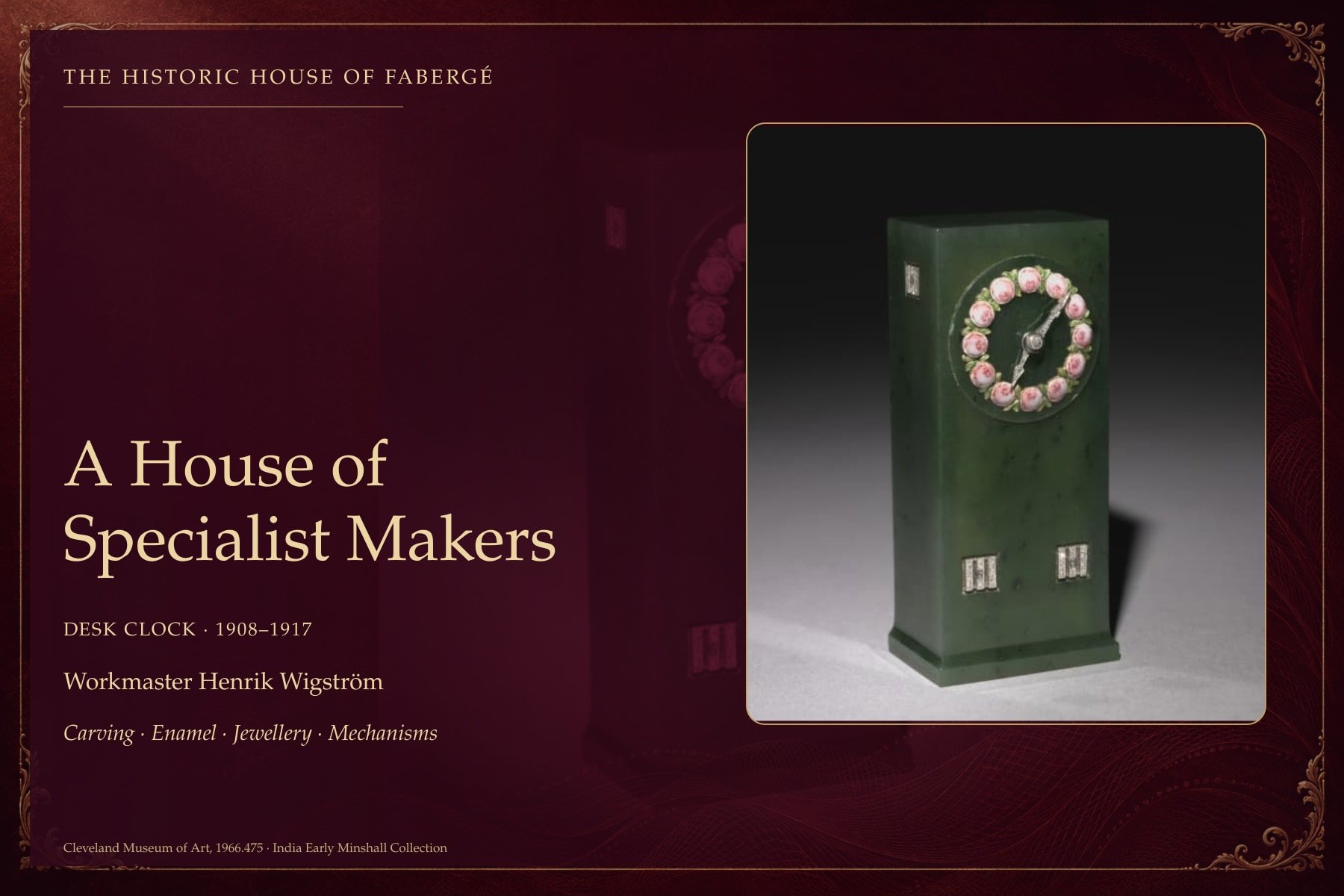
A small nephrite desk clock made under Henrik Wigström between 1908 and 1917 offers a revealing example. Its dial uses tiny enamel roses as hour markers, with diamond-set hands above the dark green stone. Timekeeping, carving, enamelling and jewellery work become parts of one composition.
Its appeal lies in the completeness of that solution. The mechanism serves a practical purpose, while the materials and decorative details give an everyday function an individual character.
Colour, Enamel and Carved Stone
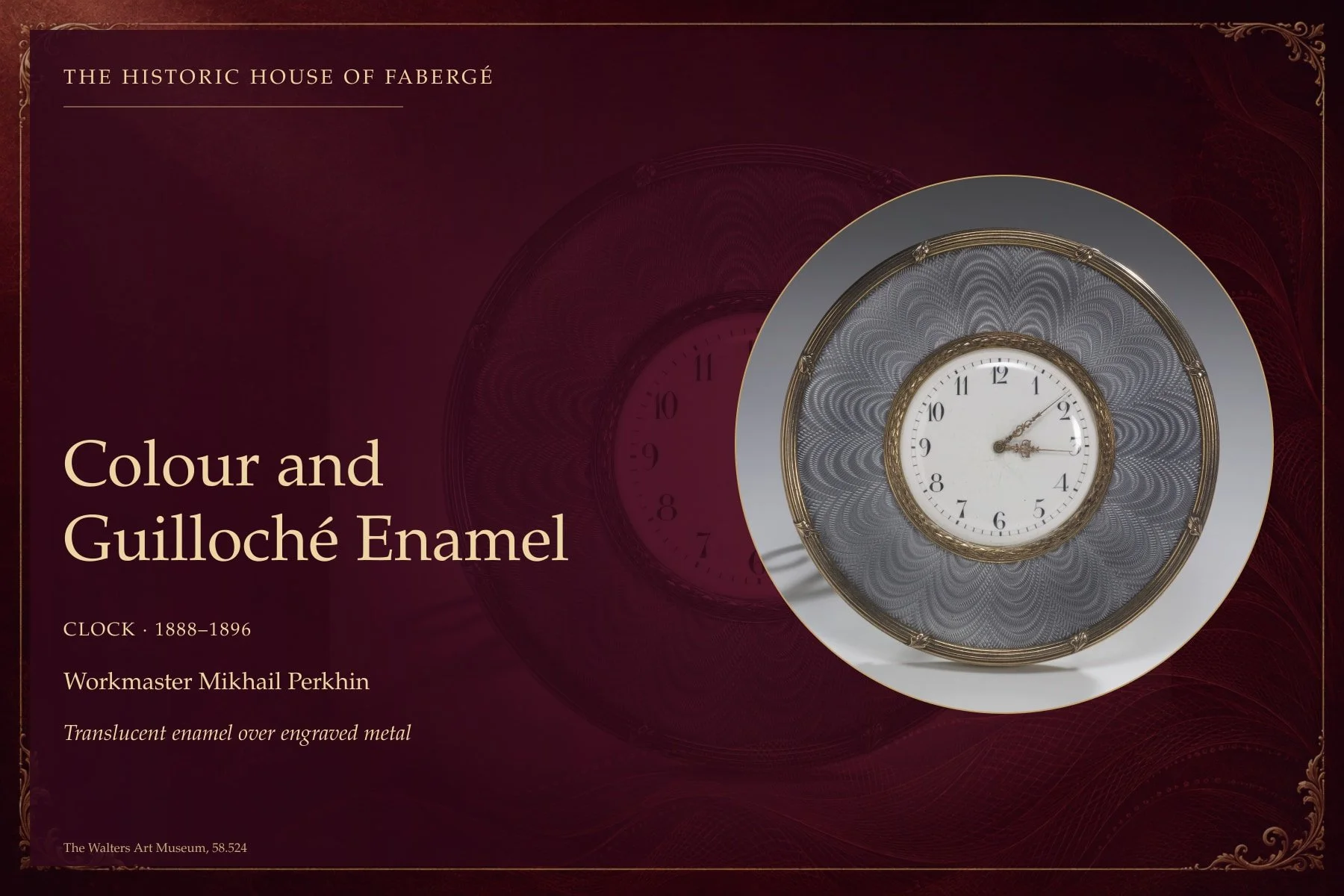
Enamel was among the historic House’s most accomplished decorative techniques. In guilloché enamel, a mechanically engraved metal surface lies beneath translucent enamel. The pattern remains visible through the colour, changing in appearance as light moves across it.
A clock made under Mikhail Perkhin between 1888 and 1896 demonstrates this effect. Its subtly coloured enamel sits over an engraved, wave-like ground, surrounded by gilded silver ornament. Viewed closely, the surface offers much more than a flat area of colour.
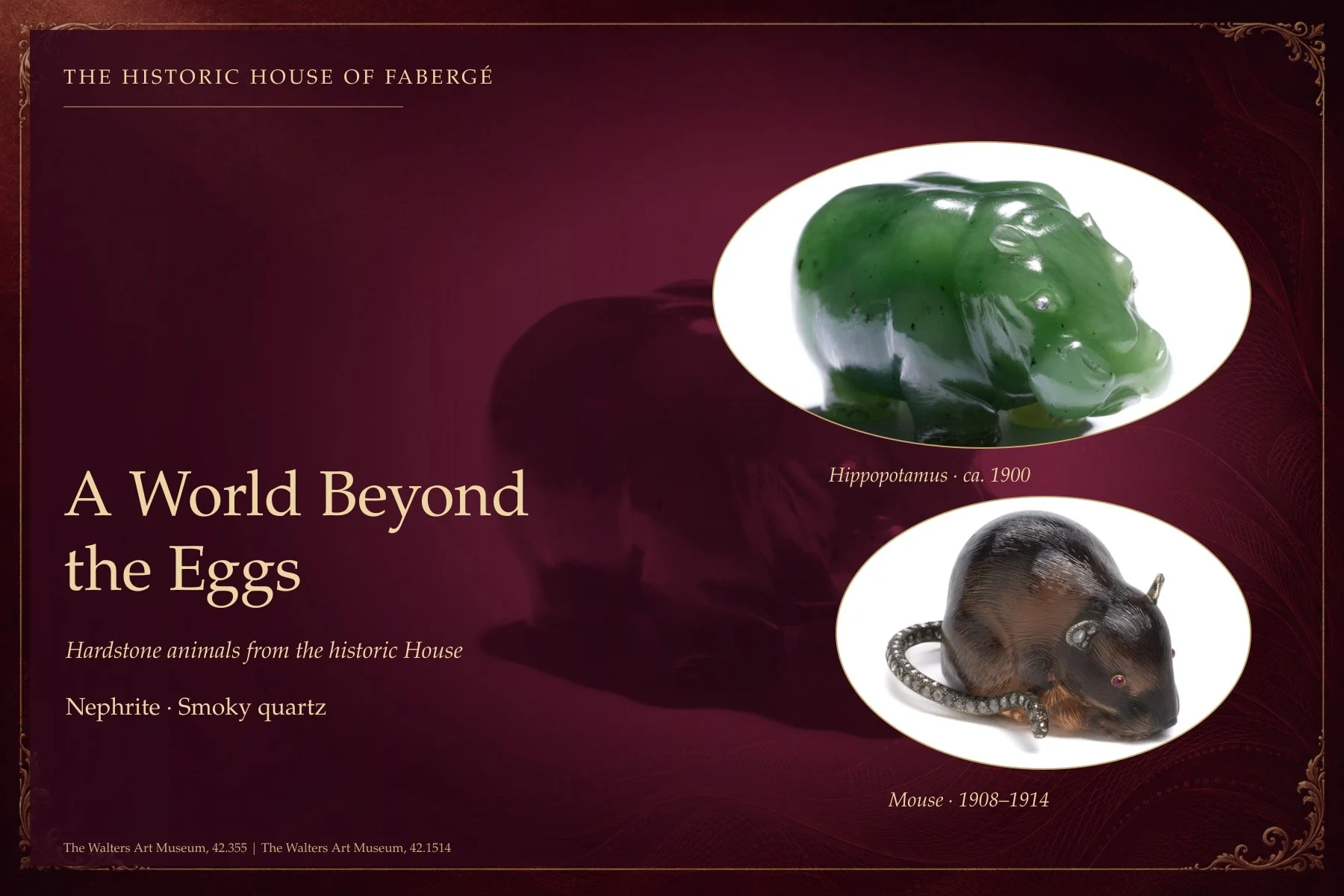
Hardstone carving demanded another kind of judgement. The material’s natural character could become part of the subject: its markings, translucency or depth of colour contributing to the impression of an animal or a plant.
Henry Walters purchased a small nephrite hippopotamus in St. Petersburg in 1900. Its rounded form and diamond eyes give the miniature animal a distinctive presence. A later smoky-quartz mouse uses carved surface detail, ruby eyes and a diamond-set tail to achieve an equally individual result.
These works reward attention to how the maker uses the material, rather than to its rarity or weight.
A World Beyond the Eggs
The House’s creative range extended to everyday objects. Photograph frames, clocks, boxes, seals, parasol handles and writing accessories gave familiar functions an artistic setting.
Other works celebrated the natural world. Carved animals and flower studies brought observation and playfulness to the collection, with scale and materials carefully chosen for each subject.
Objects could also hold personal associations. A portrait frame preserved a likeness; an animal recalled a favourite creature; a decorative box became a gift connected with its recipient’s tastes.
The Imperial Easter Eggs carried these ideas to an extraordinary level of complexity, combining exterior decoration with concealed portraits, models and mechanisms. Their achievement is easier to appreciate in this wider world of invention.
London and an International Audience
Fabergé’s reputation reached well beyond Russia. International exhibitions introduced the House’s work to new audiences, while royal relationships, travellers and private collectors helped carry its objects across borders.
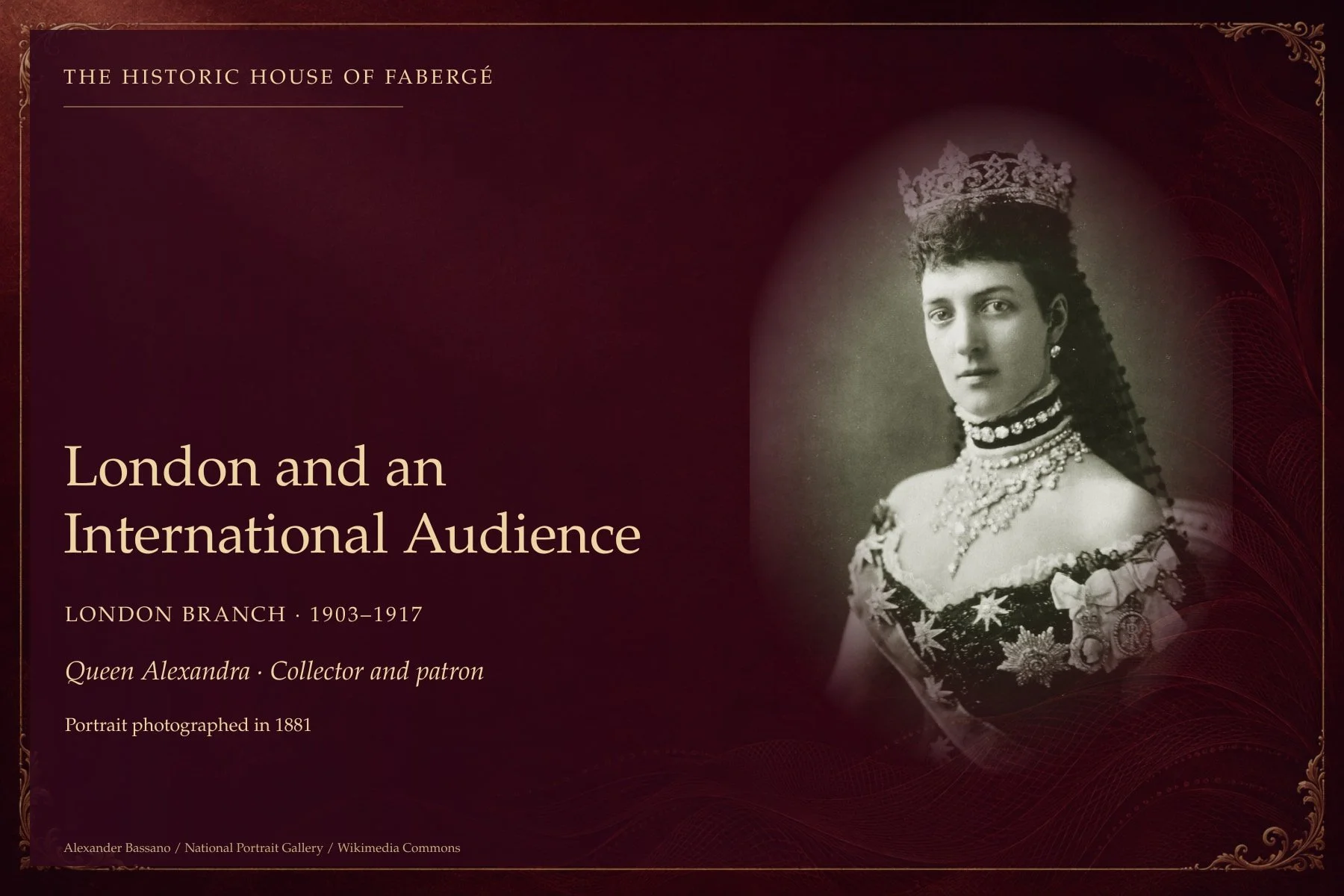
The London branch opened in 1903. Its later premises on Dover Street and, from 1911, New Bond Street brought the House into the heart of an international collecting society. King Edward VII and Queen Alexandra were enthusiastic collectors whose interest helped establish a wider British audience.
Henry Bainbridge and Carl’s youngest surviving son, Nicholas, became associated with the London business. Bainbridge’s later recollections offer a personal account of Carl and his clients, though such memories should be read alongside surviving records and objects.
War gradually diminished the branch’s activities, and it closed in early 1917. The relationships formed in Britain nevertheless became an enduring part of the family’s history.
An English Chapter Through Theo
The Russian Revolution ended the historic House’s established activities. Carl left Russia in 1918 and died in Switzerland in 1920. Nicholas remained in England, where his son Theo was born in 1922.
Theo developed his abilities through precision engineering before discovering his Fabergé ancestry in adulthood. Ornamental turning, silversmithing and an understanding of mechanisms later shaped his original designs.
The connection between grandfather and grandson is evident in artistic invention and respect for specialist skill. Theo brought his own subjects, materials and engineering experience to a body of work conceived in England.
Today, Creations Theo Fabergé continues to realise Theo’s original designs in strictly limited editions. Discover his biography, explore the Creations or examine the specialist techniques through which his artistic intentions become finished objects.